

Hill fort is focus of new archaeological digs


AN ANCIENT hill fort on Burnswark has been giving up more of its secrets.
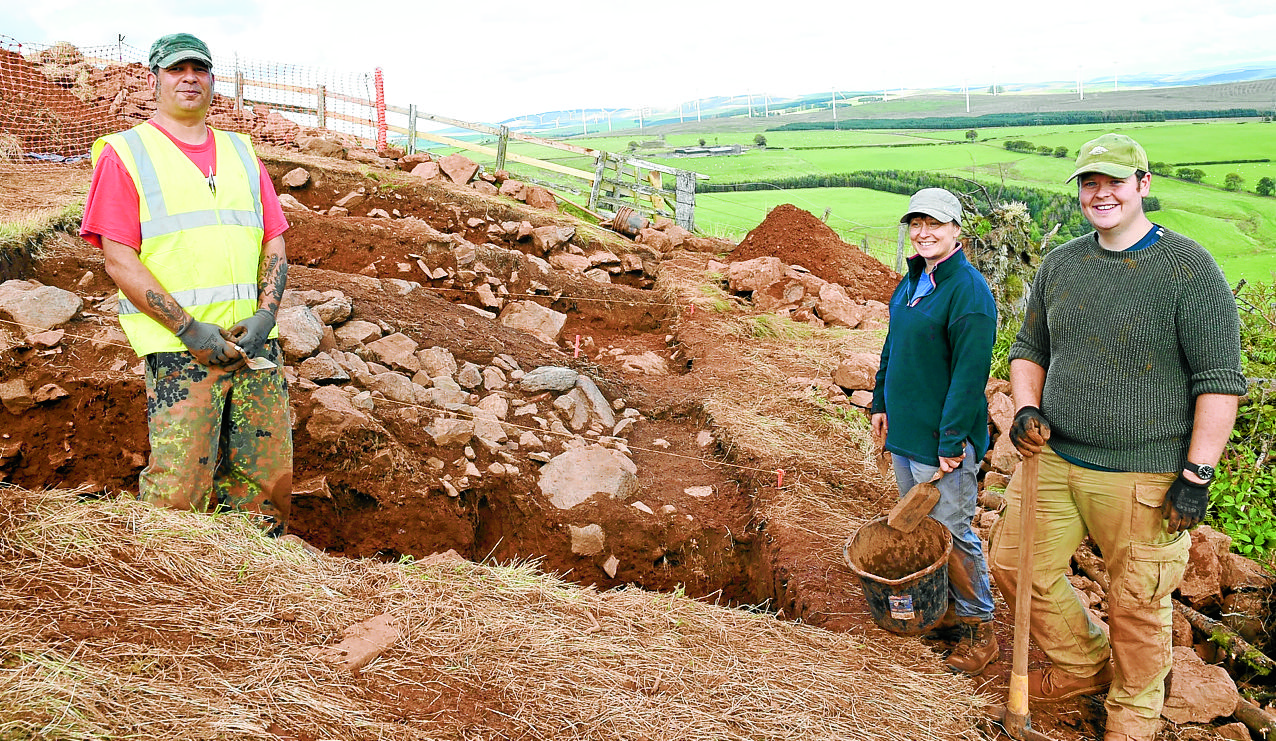
Archaeologists and students from the University of Glasgow have just finished a successful two week dig at the landmark site near Ecclefechan and Middlebie - and this time the focus is not on the Romans who were once there.
Instead, they’re going further back in time and trying to resolve “lots of questions about the hill fort that remain unanswered”.
They are already hopeful of being able to put dates on it and find out more about the settlers, who pre-date the Romans.
In what will be a long-term project, the team will return in the coming years and will be aiming to find out how densely populated it was; what was going on in the internal settlement, such as metal work or crafts; where they kept their cattle; and how it affected the local environment and landscape.
Furthermore, they really hope to be able to determine when it dates from, as well as who lived there, and when the Romans arrived on site.
[caption id="attachment_62800" align="alignnone" width="680"]
Dr James O’Driscoll is leading the project for the University of Glasgow, which is working with the Trimontium Trust and local history volunteers.
He said: “At the moment my focus is this big hill fort and internal settlement and how it then corresponds to other sites.
“The hill fort and settlement within it has been lost in the past 50/60 years.
“Burnswark is an indigenous centre for people who were born and grew up local to area. I think if we focus on the indigenous element and gain as much information about the fort, that also has the potential to answer what the Roman element of the site was and how it all connects together.”
“One of the big questions about the hill fort has always been what does it date to, so one of our main focuses is to get a really robust chronology.”
Their preliminary works included using a drone shooting laser points onto the ground, which allowed them to make a detailed and accurate 3D model of the area, which has never been done before.
James described it as ‘incredibly useful’, adding: “It identified upwards of 50 house platforms in the north west part as well as trackways that serviced those.”
Geophysical surveys in the less steep areas found ‘sub surface archaeology’ and James said: “We were able to identify lots of potential houses within that.”
Both findings have made them ‘really confident’ that there was a dense internal settlement, with potential hundreds of people living there.
[caption id="attachment_62801" align="alignnone" width="680"]
He’s hopeful they will find out more exact dates for them in the next couple of years, and also expects to make some pretty significant finds in terms of ancient items that belonged to those early folk.
However, there will be no full excavation of the seven hectares as it’s just too big and would be too costly.
“In future, we could do work in the Roman camps,” added James. “In terms of importance, Burnswark is just as important as Vindolanda
but in a very different way.”
Related News