

A salty history


SALT from the Solway was the topic of the final meeting of 2025 of the Dumfriesshire and Galloway Natural History and Antiquarian Society.
The speaker was Dr John Picken, former director of Stranraer Museum, and his talk was entitled ‘The Archaeology of Solway Salt’.
He explained that in medieval times, before refrigeration existed, this humble mineral played a much more vital role as a means of preserving perishable foodstuffs such as meat and fish. As a result, salt production was an important industry world-wide, and Dumfries and Galloway was no exception.
Two main methods of salt extraction were used. The first of these, employed in the medieval period, was known as ‘sleeching’. Dr Picken explained that this consisted of placing beach sand rich in salt crystals into a clay-lined mound (to make it impermeable) with turves in the bottom, and then adding sea water. The water leached out the salt from the sand, thus increasing its salinity until it formed a concentrated brine, strong enough ‘to float an egg’. The brine was then removed and heated over a peat fire in a small building known as a Saltcot, until the salt crystallised.
These early salt works were confined to the upper Solway, between Annan and Southerness, and, as was the case in the rest of Europe, the earliest ones, in the 12th century, were owned by monasteries, at Melrose, and Holm Cultramin in Cumbria.
While this much is known from documents, archaeological evidence is much harder to come by. Dr Picken explained this was due to the nature of the works, which were located on the shore and very susceptible to coastal erosion. One place where some archaeological remains still exist is at the Caerlaverock reserve, as exemplified by their ‘Saltcot Hide’.
In the post medieval period ‘sleeching’ was slowly abandoned in favour of a more sophisticated direct evaporation of sea water in larger pans. This change was hastened by the ‘mini ice age’ of the 14th century which made the sleeching process much less efficient. These new sites were generally located in the far west, especially on the Rhinns. Since sand was no longer needed, these could be located on more solid ground away from the shore, and there is more archaeological evidence, especially ruins of the associated stone buildings.
Dr Picken finished by emphasising that further north in Scotland salt panning was a much more industrialised process, aided by the fact that coal was available for the evaporation process. In contrast, in Dumfries and Galloway it remained essentially a ‘cottage industry’, and the salt producers often ran a small farm as well. Apart for some possible evidence from Rascarrell, coal was never used in our region.
* The society's next talk will be on Friday January 16, when Donald Henderson from Dalbeattie Museum will talk about the Titanic and its connections with Dumfries and Galloway. This will be held at The Bridge, Dumfries at 7.30 pm, and online. Further information at www.dgnhas.org.uk
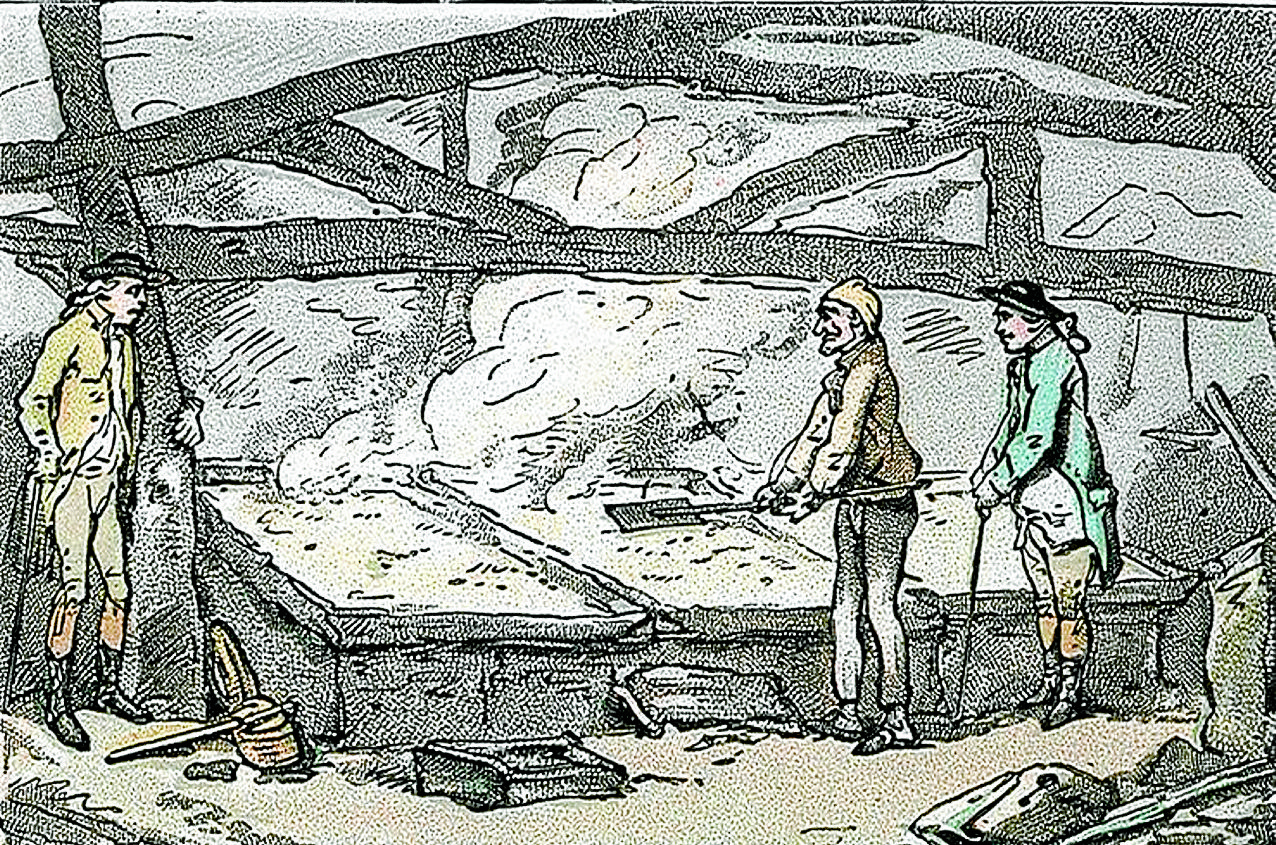
ILLUSTRATION . . . an early 19th century cartoon of salters at work
Related News